
Showing posts with label word origins. Show all posts
Showing posts with label word origins. Show all posts
Thursday, 28 February 2019
GALORE
The word “galore” means in abundance or in huge quantities and is derived from the Irish “go leór” meaning “to sufficiency, or enough.” [1] It is placed after the word it describes.
Thursday, 25 October 2018
OLD SCHOOL TIE
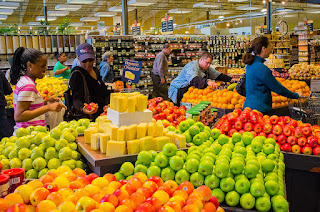
The phrase “old school tie” refers to group loyalty and attitudes associated with wearing the tie of a particular public school.


Examples
“The shadow education secretary, Angela Rayner, said: ‘The old boys’ network and the old school tie still hold back talented and hard-working people from less privileged backgrounds.’”
“In a nation long divided along the lines of the old school tie, this debate goes to the heart of what kind of country Britain wants to be.”
“Education charity Future First is running a programme at The City Academy in Homerton Row to help schools and colleges develop ‘old school tie’ networks.”
Photo Credit: Azri (Creative Commons)
Updated Monday 03 March 2020
Wednesday, 24 October 2018
THE BOTTOM LINE
Taken literally, the bottom line is an accounting term denoting the final total in an account sheet.
e.g. “It may be a few years until self-generated energy is making a real difference to the bottom line of UK companies, but even a small shift will help with making businesses more efficient and, of course, just a little bit more environmentally friendly.”

It is also used figuratively to mean the most important consideration in a situation or decision.
Examples
“The bottom line is that a new rail service through Hawick and the Scottish Borders will go a long way towards solving many of the economic and social challenges faced by the region.”
“The UK may seek to develop such ties elsewhere, but the bottom line is that our mutual relationship is irreplaceable.”
Care should be taken when using this term in financial contexts as it may be unclear whether it is being used literally or figuratively [1].
[1] “bottom line” in Fowler’s Concise Dictionary of Modern English Usage, edited by Butterfield, Jeremy. Oxford University Press, 2016.
Photo credit: Kit Carruthers (Creative Commons)
Updated Saturday 29 February 2020
e.g. “It may be a few years until self-generated energy is making a real difference to the bottom line of UK companies, but even a small shift will help with making businesses more efficient and, of course, just a little bit more environmentally friendly.”

It is also used figuratively to mean the most important consideration in a situation or decision.
Examples
“The bottom line is that a new rail service through Hawick and the Scottish Borders will go a long way towards solving many of the economic and social challenges faced by the region.”
“The UK may seek to develop such ties elsewhere, but the bottom line is that our mutual relationship is irreplaceable.”
Care should be taken when using this term in financial contexts as it may be unclear whether it is being used literally or figuratively [1].
[1] “bottom line” in Fowler’s Concise Dictionary of Modern English Usage, edited by Butterfield, Jeremy. Oxford University Press, 2016.
Photo credit: Kit Carruthers (Creative Commons)
Updated Saturday 29 February 2020
Tuesday, 23 October 2018
NO STRINGS ATTACHED
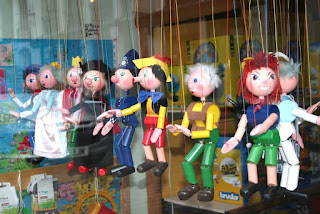
The phrase “no strings attached” means that something is offered without conditions.
This is believed to be associated with marionettes (string puppets) of 14th and 15th century France, which were controlled via strings by a puppeteer [1,2].
[1] Valeri R. Helterbran, Exploring Idioms: A Critical-thinking Resource for Grades 4–8
[2] “No strings attached” in Brewer’s Dictionary of Modern Phrase and Fable, edited by Adrian Room and Ebenezer Cobham Brewer. 2nd ed. Cassell, 2009.
Updated Monday 24 February 2020
This is believed to be associated with marionettes (string puppets) of 14th and 15th century France, which were controlled via strings by a puppeteer [1,2].

Examples
“All skill levels are welcome and can join in the fun with no strings attached.”
“Instead, the UK Government should enter into separate talks about returning the sculptures to Athens as a no-strings-attached gift.”
“In 2017, Finland became the first European country to test a government-backed unconditional basic income, which gave people a regular stipend with no strings attached.”
Photo credit: Jim McDougall (Creative Commons)
[1] Valeri R. Helterbran, Exploring Idioms: A Critical-thinking Resource for Grades 4–8
[2] “No strings attached” in Brewer’s Dictionary of Modern Phrase and Fable, edited by Adrian Room and Ebenezer Cobham Brewer. 2nd ed. Cassell, 2009.
Updated Monday 24 February 2020
Monday, 22 October 2018
(NOT) MY CUP OF TEA
If something is not your cup of tea, you don’t like or are not interested in it.

Examples
“I love getting my hands dirty and something always told me that pottery would be my cup of tea.”
“One day, when employees came to work, the big plastic containers for water were gone. They were replaced by glass carafes and mugs with a fitting sign: ‘Plastic is not my cup of tea.’”
“Muddy-coloured leaves (such as those found on that abhorrent shrub Physocarpus Diabolo) are not my cup of tea.”
The phrase reflects the British obsession with tea. It was initially used in its positive form from the 1800s, while the negative form became popular in the early 1900s. [1]
It is featured in the song “Getting to Know You” from Rodgers & Hammerstein’s “The King and I”.
Photo credit: Carol (Creative Commons)
[1] Valeri R. Helterbran, Exploring Idioms: A Critical-thinking Resource for Grades 4–8
Updated Saturday 22 February 2020

Examples
“I love getting my hands dirty and something always told me that pottery would be my cup of tea.”
“One day, when employees came to work, the big plastic containers for water were gone. They were replaced by glass carafes and mugs with a fitting sign: ‘Plastic is not my cup of tea.’”
“Muddy-coloured leaves (such as those found on that abhorrent shrub Physocarpus Diabolo) are not my cup of tea.”
The phrase reflects the British obsession with tea. It was initially used in its positive form from the 1800s, while the negative form became popular in the early 1900s. [1]
It is featured in the song “Getting to Know You” from Rodgers & Hammerstein’s “The King and I”.
Photo credit: Carol (Creative Commons)
[1] Valeri R. Helterbran, Exploring Idioms: A Critical-thinking Resource for Grades 4–8
Updated Saturday 22 February 2020
Saturday, 20 October 2018
NOSY PARKER

Examples
“Because I am a nosy parker, I’ve been interested in understanding conspiracy theories for a decade – long before it became academically trendy.”
“The organisation, which started operating in the UK in the 1980s, says it is not about being a nosy parker, and points out that tackling terrorism, modern slavery, child sexual exploitation, knife crime and online scamming of the elderly and vulnerable are top of the agenda (along with household burglary).”
“It is not known how the exotic-looking bird had found himself on the M6 in Staffordshire but it could be that the green-feathered nosy parker may have lost his way along the Midlands’ myriad of motorways.”
Why parker? It is suggested that this name was first given to someone who spied on courting couples in Hyde Park (London). It is also linked to Matthew Parker, Archbishop of Canterbury (1504–75), who had a reputation for prying into other people’s business [1].
Photo credit: Geoffrey Gilmour-Taylor (Creative Commons)
[1] “Nose” in Brewer’s Dictionary of Phrase and Fable, edited by Susie Dent. 19th ed. Chambers Harrap, 2012.
Updated Saturday 22 February 2020
Friday, 19 October 2018
HIGGLEDY-PIGGLEDY

Examples
“Bask in the beauty of England's largest (and arguably most spectacular) National Park on this rail trip to the Lake District. Cruise along Lake Windermere and then head to the higgledy-piggledy village of Hawkshead, which is full of picturesque medieval cottages.”
“Tokyo is a more jumbled city than most rich ones, but current zoning laws ensure that it is not quite as higgledy-piggledy as, say, Houston.”
“Jenners, for all its winding staircases and higgledy-piggledy layout, had all the appeal of Emile Zola’s The Ladies Paradise – a wonderful novel on the rise of department store retail.”
This phrase is thought to originate from a 16th century rhyming jingle related to the irregular herding of pigs [1].
[1] Knowles, Elizabeth. “higgledy-piggledy.” In The Oxford Dictionary of Phrase and Fable. Oxford University Press, 2005.
Photo credit: Steve Sawyer (Creative Commons)
Updated Friday 21 February 2020
Subscribe to:
Posts (Atom)